
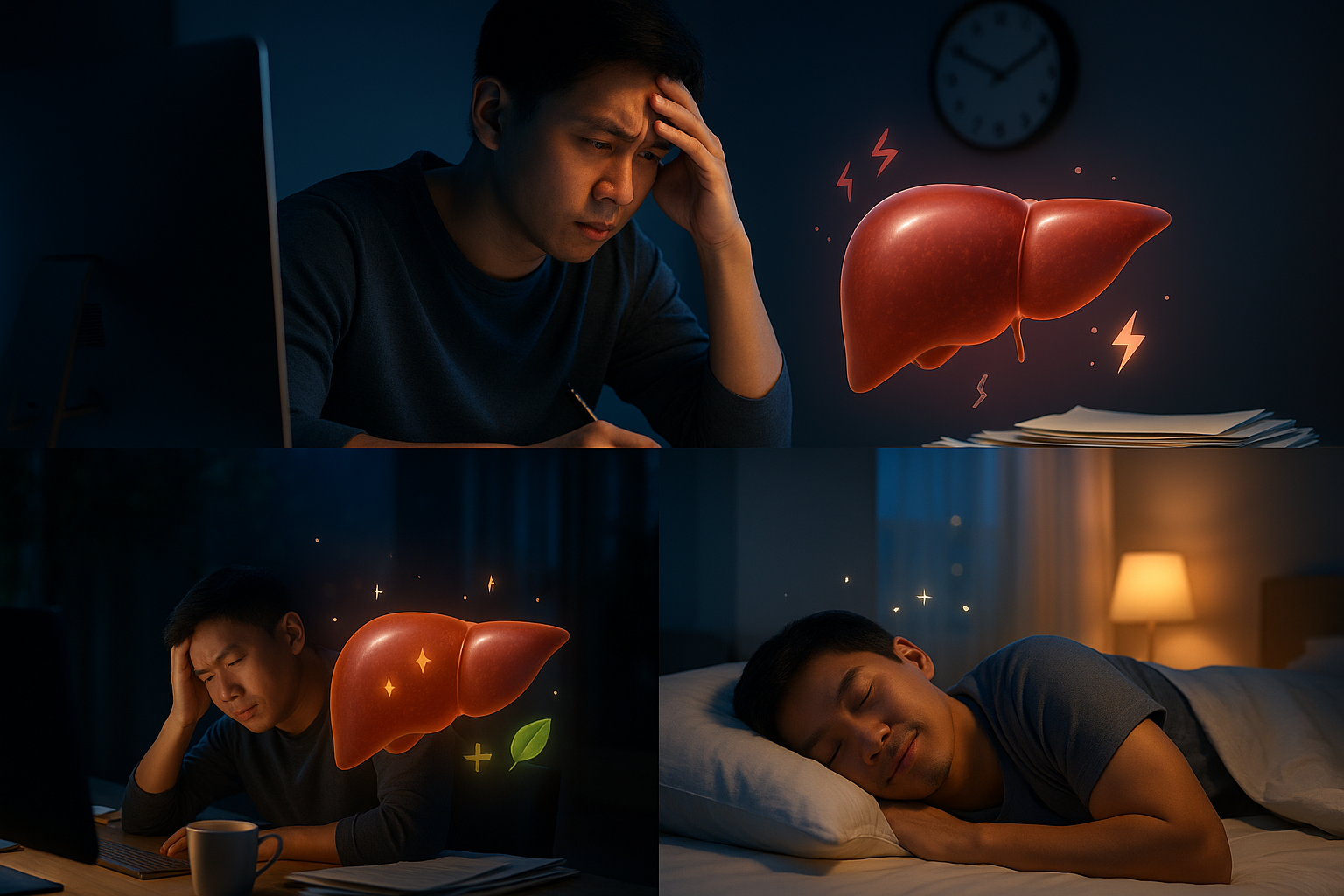
Chronic Sleep Deprivation: How Does It Stress Your Liver?
Occasional late nights, overtime work, or binge-watching shows—almost everyone has experienced these.
What truly burdens the liver is often not one or two late nights, but chronic sleep deprivation and disrupted circadian rhythms.
A growing body of research shows that people who sleep too little or poorly are more prone to fatty liver and metabolic disorders; shift workers and chronic night-shift workers have higher rates of abnormal liver enzymes; sleeping less than 7 hours per night is associated with multiple risk factors for liver disease, including obesity and type 2 diabetes.
1. First: What's the Normal Relationship Between Sleep and the Liver?
1.1 The Liver Is a "Schedule-Dependent" Organ
The human body has an approximately 24-hour circadian rhythm system:
- The brain's "master clock" distinguishes day from night;
- Each organ (including the liver) also has its own "peripheral clock," adjusting its rhythm based on cues like sleep-wake patterns, feeding, and light exposure.
For the liver, this rhythm roughly means:
- Daytime: More focused on processing energy and nutrients from food;
- Nighttime: Enters a relatively "repair and maintenance mode," completing antioxidant defense, cellular repair, and other tasks;
- Many genes related to fat and glucose metabolism show clear "peak-trough" patterns over 24 hours.
1.2 Sleep Deprivation = Disrupting the Schedule
When you frequently stay up late, don't get enough sleep, or reverse day and night:
- The brain's master clock and the liver's peripheral clock become out of sync;
- The liver receives "time to rest" signals while simultaneously being forced to "keep working" by food intake, light exposure, and stress;
- Over time, this leads to metabolic dysregulation, fat accumulation, and inflammatory responses.
In simple terms:
The liver normally works on a "daytime processing, nighttime repair" schedule.
When you chronically stay up late and sleep too little, it becomes "working day and night with no rest time."
2. Evidence #1: Sleep Deprivation and Increased Risk of Fatty Liver / MASLD
2.1 Short Sleep Duration and Fatty Liver: What Do Large Studies Show?
Multiple observational studies and meta-analyses have found:
- People with significantly insufficient sleep are more likely to develop NAFLD / MASLD;
- A systematic review incorporating multiple studies showed: People who sleep too little have a significantly increased risk of fatty liver;
- Other research found that if someone who previously slept adequately gradually reduces sleep duration or experiences worsening sleep quality, their risk of developing new-onset fatty liver significantly increases in the following years.
Some studies suggest slight differences in "short sleep" risk patterns between genders, but overall:
The vast majority of evidence points to: chronic insufficient sleep makes fatty liver and metabolic problems more likely.
2.2 It's Not Just "How Long"—Sleep Quality Matters Too
A recent study based on national population surveys indicated:
- Not only sleep duration, but when multiple sleep dimensions—such as difficulty falling asleep, frequent awakenings, and snoring—deteriorate together, the risk of fatty liver / MASLD increases significantly.
In other words:
"Sleeping enough but sleeping poorly" may impact the liver and metabolism as much as "sleeping too little."
3. Evidence #2: Sleep Deprivation and Abnormal Liver Enzymes / Metabolic Markers
3.1 Short Sleep and Elevated Liver Enzymes
Multiple studies have found that people with chronically short sleep duration more commonly have abnormal liver enzymes like ALT, AST, and γ-GTP:
- A Korean cross-sectional study found that people with excessively short sleep had a higher proportion of abnormal liver enzymes, with researchers suggesting that sleep deprivation may increase fatty liver risk through metabolic dysregulation.
- Other research showed that when chronic sleep deprivation combines with other unhealthy lifestyle factors (sedentary behavior, alcohol consumption, obesity), the risk of elevated γ-GTP becomes more pronounced.
3.2 Sleep, Body Weight, Blood Sugar, and Insulin Resistance
An expert consensus from the American Academy of Sleep Medicine states:
- Adults who chronically sleep less than 7 hours per night are associated with obesity, type 2 diabetes, hypertension, cardiovascular disease, and various other adverse outcomes.
And these conditions are themselves core risk factors for fatty liver / MASLD:
- Sleep deprivation → Hormonal imbalances (e.g., elevated cortisol), disrupted appetite regulation → Greater cravings for high-sugar, high-fat foods;
- Sleep deprivation → Decreased insulin sensitivity → Higher likelihood of hyperglycemia and insulin resistance;
- Insulin resistance + high-energy diet → Hepatic fat accumulation and increased inflammatory responses.
So, from an indirect pathway perspective:
Sleep deprivation → Loss of control over weight, blood sugar, and lipids → Significantly increased fatty liver and liver metabolic stress.
4. Evidence #3: The Special Challenge of Shift Work / Night Shifts for the Liver
4.1 Night Shifts, Liver Enzymes, and Blood Lipids
Many studies have focused on populations such as nurses and workers with chronic shift work or night shifts:
- Shift workers have a slightly higher risk of abnormal liver enzymes, suggesting circadian disruption may play a role;
- Long-term day-night rotation is associated with liver function and lipid abnormalities;
- Systematic reviews indicate: Shift work disrupts the biological clock, increasing the risk of MASLD and its progression to more severe liver disease.
4.2 Circadian Disruption Itself Can "Promote Fatty Liver"
Research on hepatic circadian rhythms shows:
- "Clock genes" within liver cells regulate lipid synthesis, fatty acid oxidation, and cholesterol metabolism;
- When the biological clock is disrupted (e.g., chronic night shifts, frequent jet lag, severe sleep deprivation), the liver is more prone to lipid accumulation and inflammatory responses.
Therefore, for occupational groups requiring shift work,
How to minimize the impact of circadian disruption on the liver under unavoidable night-shift conditions is a very practical concern.
5. Mechanistically: How Does Sleep Deprivation "Stress" the Liver?
5.1 Hormonal and Nervous System "Accelerating the Gas Pedal"
Chronic sleep deprivation leads to:
- Elevated cortisol levels, with chronic sympathetic nervous system activation;
- Imbalanced appetite hormones (leptin, ghrelin), leading to increased hunger and preference for high-calorie foods;
- Decreased insulin sensitivity, resulting in poorer blood glucose control.
These changes force the liver to process more fat and sugar. In the long run, it's like:
"The gas pedal is constantly pressed, but the brakes have failed."
5.2 Nighttime Liver Repair Time Gets Compressed
Nighttime is a crucial period for the liver to complete many "repair tasks":
- Antioxidant defense systems become more active, clearing free radicals and metabolic waste accumulated during the day;
- Some DNA repair and cell renewal processes are more active at night;
- The immune system also undergoes "maintenance" during this period.
If you chronically go to bed very late and have significantly insufficient sleep duration,
the time available for liver "repair" is squeezed out, making accumulated damage harder to repair promptly.
5.3 The "Bidirectional Relationship" Between Liver and Circadian Clock
Recent research even suggests:
- Not only do sleep and circadian rhythms affect the liver, but liver disease itself can disrupt sleep, creating a "vicious cycle."
For example:
- Some patients with fatty liver or cirrhosis report poor nighttime sleep and severe daytime drowsiness;
- This may stem from metabolic and inflammatory factors, as well as coexisting conditions like sleep apnea, depression, or anxiety.
6. What Counts as "Chronic Sleep Deprivation"? How Much Sleep Is Enough?
Authoritative sleep societies provide these general standards:
- Healthy adults: Should get ≥ 7 hours of sleep per night, with many guidelines recommending 7–9 hours;
- Chronically less than 7 hours, especially frequently ≤ 6 hours, is associated with increased metabolic and cardiovascular risks.
Of course, individual sleep needs vary, but if you meet at least one of the following, you should be alert to sleep deprivation:
- Most weekdays, you only sleep 5–6 hours or less;
- Even with weekend catch-up sleep, you still chronically feel fatigued with declining concentration;
- Your weight, blood pressure, blood sugar, and waist circumference have increased noticeably in recent years;
- Medical checkups show fatty liver or mildly abnormal liver enzymes, while you chronically don't get enough sleep.
7. Starting Today: What Improvements Can You Make?
The goal isn't "becoming a perfect sleeper overnight,"
but rather, within real-life constraints, nudging the sleep-liver relationship in a better direction.
7.1 Leave Enough Time for the Liver's "Repair Window"
- Try to go to bed and wake up at consistent times, even if initially it's just 30 minutes earlier than now;
- Gradually extend sleep duration to 7+ hours, rather than relying on weekend "revenge sleep" in one go;
- Have dinner earlier and avoid heavy meals or excessive alcohol before bed, so the liver and digestive system don't work overtime at night.
7.2 Create a Sleep-Friendly Environment
- Minimize screen time 1 hour before bed to reduce blue light stimulation;
- Keep the bedroom quiet, dark, and slightly cool;
- Don't turn your bed into an "office" or "phone-scrolling battlefield"—use it mainly for sleep and intimacy.
7.3 Manage Weight and Metabolism for "Win-Win" Benefits to Sleep and Liver
- Regular exercise can simultaneously improve sleep quality, weight control, and insulin sensitivity;
- Limit sugary drinks, refined carbohydrates, and high-fat diets—this helps reduce liver burden and promotes more restful nighttime sleep;
- Avoid relying on large amounts of alcohol to "help sleep"—in the long run, it only worsens both liver health and sleep quality.
7.4 "Damage Control" for Night Shift / Shift Workers
If your job unavoidably involves night shifts, you can try:
- Maintain a fixed shift rotation, avoiding frequent switching between different shifts;
- After finishing a night shift, ensure you have a relatively fixed, quiet sleep period—use blackout curtains, earplugs, etc., to simulate a "nighttime environment" as much as possible;
- On non-night-shift days, also try to maintain similar sleep-wake times to reduce "day-night flip-flopping";
- Pay extra attention to weight management, blood pressure, and blood sugar monitoring—regularly check liver function and liver imaging during health checkups.
8. When Should You Seek Professional Help?
If you have any of the following, consider seeking medical attention or consulting a professional:
- Persistent difficulty falling asleep, early awakening, excessive dreaming, or waking up still very fatigued for more than 3 months;
- Severe daytime drowsiness affecting work and driving safety;
- Accompanied by snoring, breathing pauses, or waking up gasping at night (possibly related to sleep apnea);
- Previous or recent medical checkups showing elevated liver enzymes, fatty liver / MASLD, along with chronically insufficient sleep duration or obviously poor sleep quality.
During your visit, proactively share your sleep patterns, work shifts, dietary habits, and weight changes with your doctor.
This helps the physician comprehensively assess: to what extent are liver issues related to sleep and lifestyle factors.
9. Conclusion: Give Your Liver Some "Nighttime Breathing Room"
- The liver is a highly rhythm-dependent organ—processing metabolism during the day, completing repair at night;
- Chronic sleep deprivation and disrupted schedules rob the liver of its repair window, increase metabolic burden, and are associated with fatty liver / MASLD and abnormal liver enzymes;
- Good news: Sleep can be gradually improved through behavioral habits—even just sleeping half an hour more than yesterday or skipping one late night sends your liver a signal: "I'm starting to take care of you."
You don't need to be perfect overnight—just start today,
reserving a bit more high-quality sleep time for yourself and your liver.
Important Notice
The content of this article is for health education purposes only and cannot replace a doctor's diagnosis or treatment advice.
If you have been diagnosed with liver disease, sleep disorders, or are taking long-term medications, please consult a professional physician or qualified healthcare provider before adjusting your schedule, using any supplements, or medications.